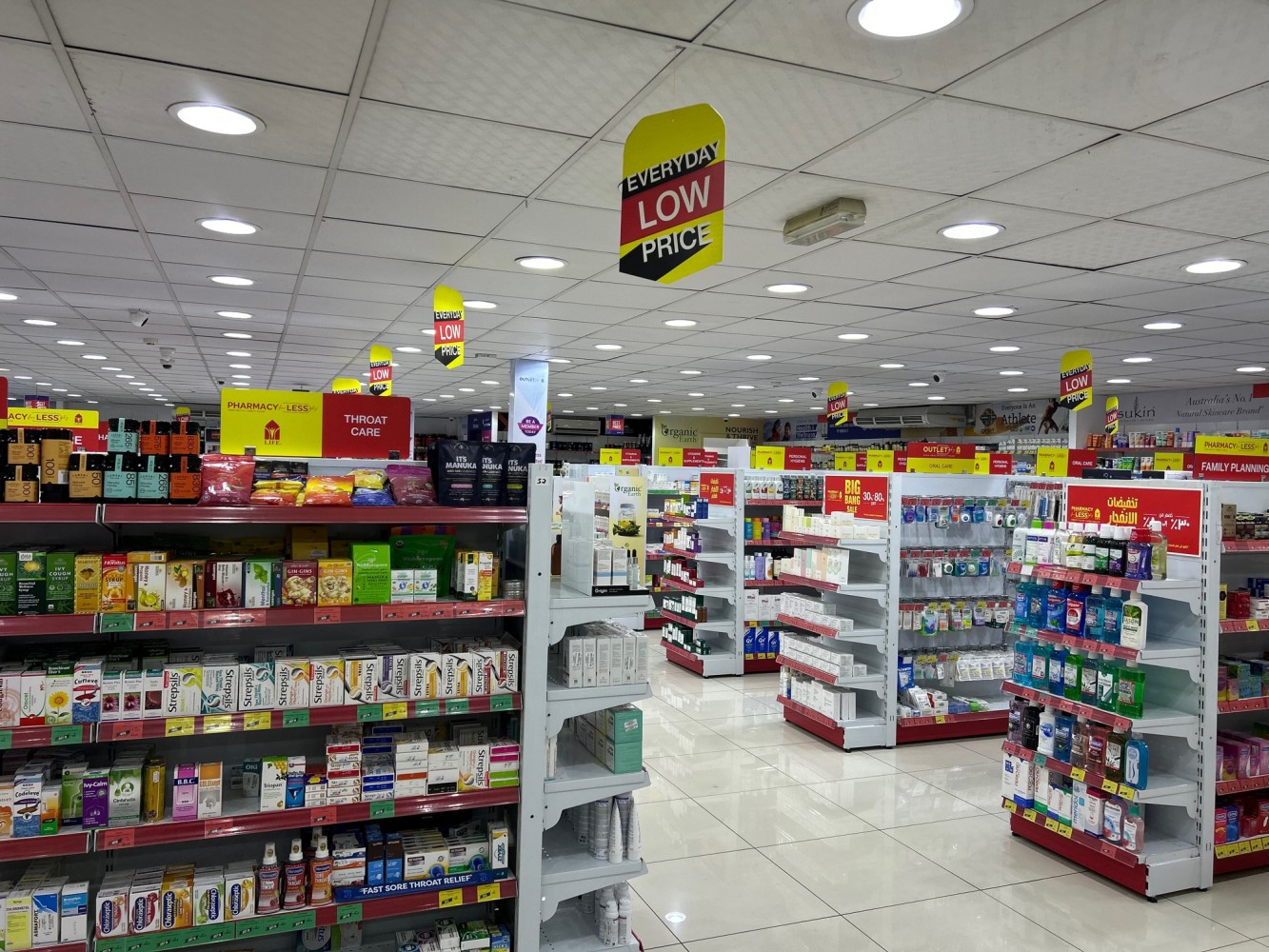
Why pharmacy flooring is more than an aesthetic decision — and how to choose materials that support hygiene, safety, durability and long-term business performance.
Carpet in Pharmacies? It’s Time to Rethink This Choice
During my travels across the United States, I have visited countless pharmacies, observing their layouts, furnishings, customer journeys and overall design.
And there is one detail that continues to surprise me.
Carpet flooring. In pharmacies.
It may seem like a minor architectural choice, but it raises some important questions.
Why are so many healthcare retail environments still using a flooring material that can be difficult to maintain, especially in areas exposed to constant foot traffic?
Carpet can create a warm atmosphere, reduce noise and make a space feel more comfortable. These are understandable reasons for choosing it.
But a pharmacy is not an ordinary retail store.
It is a place where people seek healthcare advice, collect prescriptions, purchase medicines and increasingly access professional services.
Every design decision should therefore consider not only appearance, but also functionality, hygiene, accessibility and long-term maintenance.
And flooring is certainly no exception.
1. Hygiene and Cleaning: The First Concern
A pharmacy welcomes dozens, sometimes hundreds, of people every day.
Customers, pharmacists, healthcare professionals, delivery personnel and visitors continuously move through the same environment.
With every visit, dust, dirt and moisture can enter the premises.
Carpet fibers can retain particles and require specific cleaning procedures, especially when spills occur.
This does not mean that every carpeted space is automatically unhygienic. With proper maintenance, carpeting can be managed in certain healthcare settings.
However, it does create additional cleaning considerations compared with many nonporous flooring materials.
The Centers for Disease Control and Prevention (CDC) recommends avoiding carpeting in high-traffic patient-care areas or locations where spills are likely.
For pharmacy owners, this is an important consideration, particularly when planning consultation rooms, clinical service areas and high-traffic circulation routes.
The objective is not simply to have a floor that looks clean. It is to choose a surface that can be cleaned effectively and maintained consistently.
2. Maintenance Costs: The Expense You Don’t See at First
When planning a pharmacy renovation, flooring decisions are often influenced by the initial installation cost.
But the purchase price represents only one part of the investment.
Carpet requires regular vacuuming, periodic deep cleaning and prompt treatment of spills.
Depending on the material quality and intensity of use, certain areas may also need repair or replacement as they wear.
Now consider a pharmacy that operates for extended hours, welcomes substantial daily foot traffic and has limited opportunities to close sections for maintenance.
Cleaning and replacement become operational issues as well as financial ones.
Choosing a flooring material therefore means evaluating its entire lifecycle.
How frequently will it need cleaning?
Can damaged sections be repaired?
How long is the expected service life?
Will maintenance interrupt normal pharmacy operations?
These questions should be answered before the material is selected.
At Sartoretto Verna, our approach to pharmacy architecture and interior design considers material performance alongside aesthetics, workflows and the long-term needs of the business.
Because a flooring decision that appears economical today may become more expensive over time.
3. Accessibility and Safety: Design for Every Customer
Pharmacies serve people of every age and ability.
Older adults, wheelchair users, parents with strollers and customers with temporary mobility difficulties should all be able to move comfortably through the environment.
The flooring plays an important role in that experience.
Carpets with unsuitable backing, excessive pile thickness or poorly secured edges can increase mobility resistance or create difficulties.
In the United States, the ADA Accessibility Standards specify requirements for accessible floor surfaces and carpeting.
Among other considerations, accessible flooring must be stable, firm and slip-resistant.
Carpet, where permitted, must comply with installation and pile-height requirements.
These principles highlight a broader point.
Accessibility should be integrated into the architecture from the beginning, not treated as a correction after the pharmacy has been completed.
The same applies to hard flooring.
A polished surface may look impressive, but its slip resistance, particularly when wet, must be carefully assessed.
The right solution is not simply the hardest or smoothest material.
It is a surface appropriate for the activities, customers and conditions of the specific environment.
4. The Customer Experience Begins with the Floor
First impressions are formed before a customer even reaches the pharmacy counter.
Lighting, spatial organization, colors, furnishings and finishes all contribute to how an environment is perceived.
And the floor occupies a substantial visual area.
A worn, stained or outdated surface can undermine the impression created by otherwise well-designed interiors.
It may make the space feel older than it actually is.
Conversely, carefully selected flooring can strengthen the pharmacy’s visual identity and create continuity between different areas.
Large-format porcelain tiles can produce a clean, contemporary atmosphere.
Wood-look resilient flooring can bring warmth without relying on textile surfaces.
Terrazzo-inspired finishes can introduce character while maintaining a professional appearance.
The possibilities are extensive.
The real challenge is selecting a material that communicates the desired identity while performing effectively in everyday use.
Through our pharmacy moodboard development process, Sartoretto Verna explores how materials, textures, lighting and colors work together to create a coherent architectural experience.
Materials should never be selected in isolation.
They must contribute to the complete concept while responding to practical operational requirements.
5. What Are the Best Flooring Alternatives for Pharmacies?
Fortunately, today there are several flooring solutions that combine durability, design flexibility and easier maintenance.
The choice depends on the pharmacy’s activities, budget, local building regulations and expected traffic.
Porcelain Tiles: Durability and Design Flexibility
Porcelain tiles are among the most versatile solutions for contemporary pharmacy interiors.
They offer good resistance to wear and staining and are available in a wide range of colors, dimensions and textures.
Stone, concrete and wood-inspired finishes can be used to create different architectural identities without relying on the maintenance requirements of the natural materials they imitate.
However, tile selection should also consider slip resistance, grout joints, substrate conditions and compatibility with the cleaning products used.
For high-traffic pharmacy areas, porcelain can be an effective long-term solution when correctly specified and installed.
Commercial Vinyl Flooring: Comfort and Versatility
Commercial vinyl flooring, including suitable luxury vinyl tile and plank products, offers numerous aesthetic possibilities.
Wood and stone effects allow pharmacies to create warmer interiors without using natural timber or carpet.
Depending on the product and installation system, vinyl flooring can provide good resilience, ease of cleaning and acoustic benefits.
However, not every vinyl product is appropriate for every healthcare area.
Particular attention should be paid to seams, moisture resistance, wear layers and compatibility with the required cleaning and disinfection procedures.
Resin Flooring: Seamless Contemporary Surfaces
Resin flooring systems can create continuous surfaces with a contemporary architectural appearance.
When correctly designed and installed, appropriate resin systems can offer good resistance to wear and facilitate cleaning.
They may be particularly useful in specific healthcare or technical areas where a continuous surface is desirable.
The final specification must consider substrate preparation, expected loads, slip resistance, chemical compatibility and maintenance requirements.
A seamless appearance does not eliminate the need for proper cleaning or make a surface maintenance-free.
Natural Rubber: Comfort for Staff
Pharmacy employees frequently spend long periods standing and moving between workstations.
For this reason, flooring comfort deserves consideration.
Commercial rubber flooring can offer resilience and acoustic benefits, making it an option worth evaluating for selected working areas.
Behind counters, in back-office spaces or in appropriate professional zones, it may contribute to a more comfortable working environment.
As with other materials, the exact product must be checked for slip resistance, cleanability and compatibility with the intended use.
Commercial Linoleum: A Material Worth Reconsidering
Modern commercial linoleum is another flooring option that can be considered for pharmacy environments.
Available in contemporary colors and finishes, it can support distinctive design concepts while offering a resilient surface.
Its material composition may also appeal to projects with specific environmental objectives.
However, sustainability claims should be evaluated using product-specific environmental documentation, while cleaning, moisture exposure and installation requirements must be assessed carefully.
Polished Concrete: Industrial Character, Practical Considerations
Polished concrete offers a minimalist, industrial-inspired appearance that can be particularly interesting for contemporary retail concepts.
It can be durable and visually striking.
However, the final surface treatment, slip resistance, staining behavior, maintenance procedures and suitability of the existing substrate must all be evaluated.
It should never be selected based on appearance alone.
6. Flooring Should Be Part of the Pharmacy Business Strategy
There is another aspect of flooring that pharmacy owners often underestimate.
Its relationship with business performance.
A pharmacy renovation is an investment, and every material should support the way the business operates.
A floor that requires frequent intervention may create additional operating expenses.
A poorly chosen surface may affect accessibility or complicate daily cleaning.
A fragmented combination of finishes can weaken visual consistency and make the pharmacy feel less organized.
By contrast, a well-planned flooring strategy can support efficient maintenance, customer circulation, visual identity and staff comfort.
This is why material selection should come after an analysis of the pharmacy’s requirements.
What kind of pharmacy are we designing?
How many customers will it welcome?
Which activities will take place in different areas?
What level of cleaning and maintenance will be required?
And how does the material investment fit into the overall renovation budget?
At Sartoretto Verna, these questions are part of a larger process.
As Pharmacy Business Architects, we approach pharmacy design by connecting commercial objectives, spatial organization and architectural solutions.
Our Sartoretto Verna Method begins with the specific challenges of each pharmacy, rather than applying the same design formula to every project.
The result should be an environment that not only looks different, but functions better.
Before Replacing Your Pharmacy Carpet, Consider the Whole Space
If your pharmacy still has carpet flooring, replacement may be worth evaluating as part of a broader improvement project.
But simply installing a new floor will not solve every architectural or operational problem.
A renovation offers an opportunity to reassess customer circulation, display areas, consultation spaces, staff workflows and the visual identity of the pharmacy.
The right flooring material should support all these elements.
It should be easy to maintain, appropriate for the intended activities, accessible and consistent with the overall design.
Most importantly, it should continue performing long after the inauguration photographs have been taken.
Good pharmacy design is not only what customers see on opening day. It is what continues to work, every single day.
Is Your Pharmacy Ready for a Smarter Renovation?
Choosing the right flooring is only one of the many decisions involved in designing a successful pharmacy.
Sartoretto Verna combines architecture, material research, retail strategy and operational analysis to create pharmacy environments that balance visual identity, functionality and long-term performance.
Whether you are planning a complete renovation or developing a new pharmacy concept, the starting point should always be a clear understanding of your business and the space it needs.
Explore our pharmacy design approach or book a consultation with our team to discuss your next project.