From Houston to Austin and San Antonio, Fiona Sartoretto Verna explores what independent pharmacies are missing — and why the future requires more than another renovation.
10 Days, 48 Pharmacies, and Thousands of Miles Across Texas
Every time Fiona Sartoretto Verna lands in the United States, her pharmacy safari begins.
A rental car, Google Maps, countless miles on the road and one mission: understanding how pharmacies are evolving, what they are doing right and where they are missing opportunities.
This time, the destination was Texas.
Ten intense days between Houston, Austin and San Antonio. Forty-eight pharmacies visited, thousands of miles traveled, plenty of chai latte and temperatures that made moving between the Texas heat and heavily air-conditioned buildings an experience of its own.
The journey also included the Texas Pharmacy Association Conference & Expo, where Fiona met independent pharmacy owners, listened to their challenges and shared Sartoretto Verna’s vision of the future of pharmacy.
But the most revealing lessons came from the pharmacies themselves.
For this trip, Fiona introduced something new into her Pharmacy Safari: artificial intelligence.
Rather than selecting pharmacies randomly, she used AI to identify independent pharmacies worth visiting across different neighborhoods and cities.
The objective was not to produce a scientific ranking or judge an entire national market.
It was to observe, compare and understand how independent pharmacies present themselves to their communities.
Forty-eight pharmacies. Forty-eight opportunities to see where independent pharmacy is heading.
And what she found raised some uncomfortable questions.
The Invisible Pharmacy: When Your Community Cannot Find You
One of the most surprising observations had nothing to do with the products or services inside the pharmacies.
It was the difficulty of finding them.
In several cases, Fiona arrived at the address indicated by GPS but struggled to identify the pharmacy.
No clearly visible signage, recognizable storefron, distinctive identity.
Sometimes, even people nearby did not know where the pharmacy was located.
This is particularly striking in the United States, a country that has played an influential role in the development of modern branding and corporate identity.
Yet many of the independent pharmacies Fiona visited appeared to communicate very little about what made them different.
Similar symbols, generic graphics and limited external communication created an almost interchangeable image.
And this raises a fundamental business question.
If customers cannot recognize your pharmacy, how can they recognize its value?
Brand identity is much more than a logo.
It includes architecture, signage, communication, customer experience and the way a business presents itself within its community.
A recognizable pharmacy should communicate who it is, what it offers and why people should choose it.
This is why Sartoretto Verna approaches pharmacy business strategy by analyzing positioning and identity before making architectural decisions.
A pharmacy should never be invisible to the people it is designed to serve.
Inside the Pharmacy: Is This Really a Healthcare Destination?
Once inside, the observations became even more revealing.
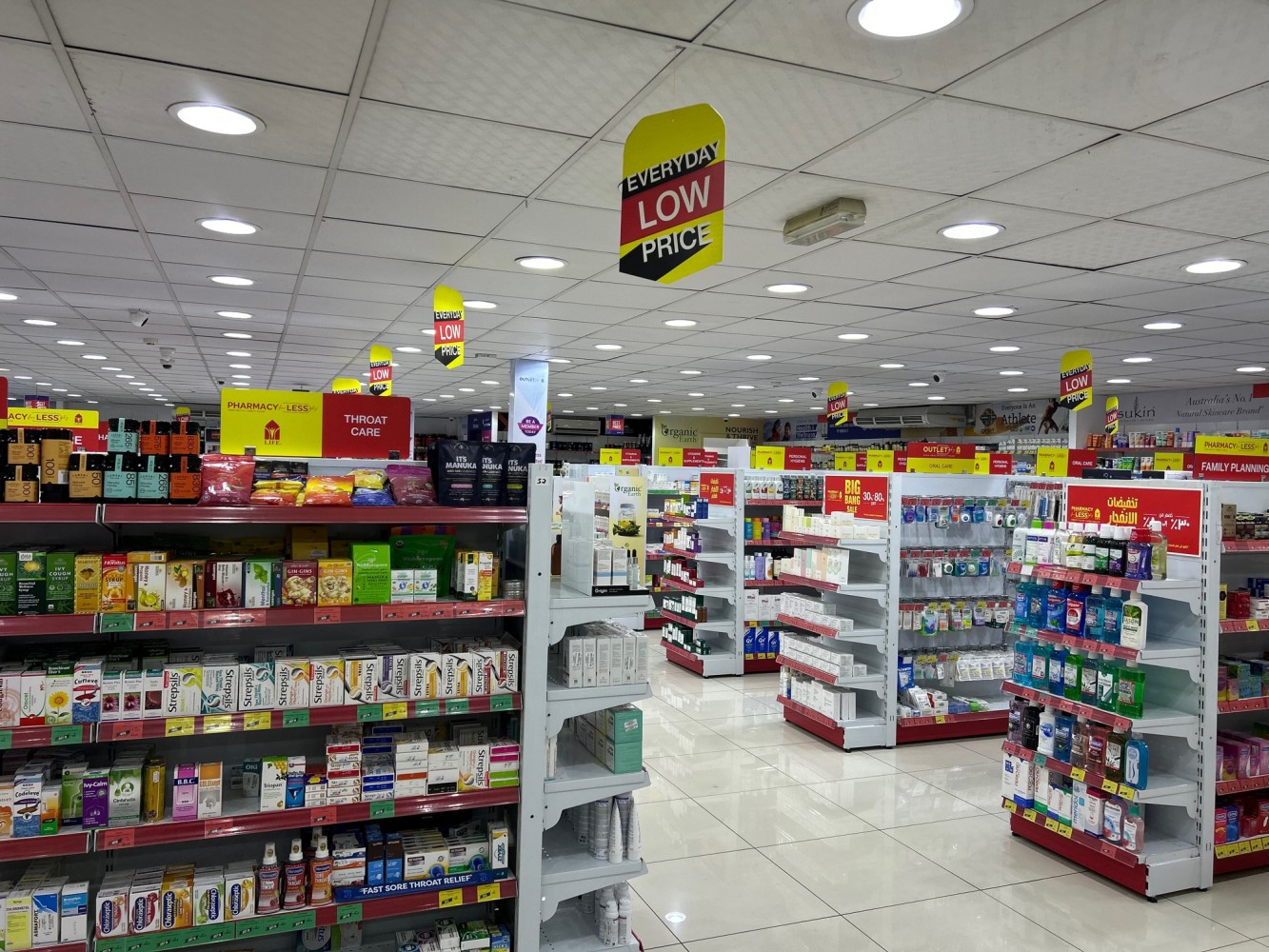
Some pharmacies had layouts that appeared confusing or outdated.
Products were displayed without a clear category strategy. Shelves were sometimes half-empty, while other areas were crowded with unrelated merchandise.
Damaged fixtures, worn finishes, dirty carpeting and poor lighting contributed to an environment that did not always reflect the professional value of the people working there.
In some locations, the pharmacy appeared to operate primarily as a prescription pickup point.
Customers approached a counter or window, collected their prescriptions and left.
The physical separation between patients and pharmacists reduced opportunities for interaction.
And in an industry where trust and professional relationships should represent a major competitive advantage, this deserves attention.
Of course, every pharmacy has different operational requirements, and secure dispensing areas remain essential.
But the question is whether the overall environment helps or hinders the relationship between the pharmacy team and its customers.
A pharmacy should not feel like a warehouse with a prescription counter. It should communicate health, expertise and professional care.
This does not require luxury materials or an expensive architectural concept.
It requires organization, maintenance, clear communication and a layout that responds to the needs of the people using the space.
Walk Into Your Pharmacy as if You Were a Patient
One of the most valuable lessons from Fiona’s Texas Pharmacy Safari is also one of the simplest.
Leave your pharmacy.
Walk outside.
Then come back in as if you were entering for the first time.
Forget, for a moment, that you are the owner.
Look at the entrance. Observe the windows and signage. Pay attention to the first things you see.
Can you immediately understand where to go?
Are the products organized logically?
Are the available services clearly communicated?
Does the environment feel clean, comfortable and professional?
Can you easily identify the pharmacist and ask for advice?
This simple exercise can reveal problems that become invisible after years of working in the same environment.
When we see something every day, we often stop noticing it.
Customers do not have that familiarity.
Their perception begins the moment they approach the building and continues throughout every interaction.
In pharmacy design, the customer journey is not a decorative concept. It is a practical way of understanding how space influences behavior and experience.
At Sartoretto Verna, these observations are part of our pharmacy design method.
Before choosing furniture, materials or colors, we examine how a pharmacy functions, how customers move through it and which problems the project needs to solve.
Professional Services That Nobody Knows About
Another important finding concerned healthcare services.
Some pharmacies offered additional professional activities, yet those services were barely visible.
There was little signage, no clear explanation and limited information helping patients understand what was available.
Sometimes, the pharmacist was the only person who seemed to know the full range of services being offered.
This represents a missed opportunity.
A pharmacy may invest in professional training, equipment and new healthcare services, but those investments cannot deliver their full potential if customers are unaware of them.
Communication is part of the service experience.
A consultation area should be identifiable.
Patients should be able to understand which services are available and how to access them.
Professional expertise should be communicated clearly, without turning healthcare into aggressive commercial promotion.
The goal is to make valuable services easier to discover and use.
For independent pharmacies, this is especially important.
As competition increases, professional services can contribute to differentiation, stronger patient relationships and additional business opportunities.
But they must be supported by a coherent strategy.
Meanwhile, Healthcare Is Evolving Just a Few Blocks Away
Perhaps the strongest contrast Fiona observed during her Texas journey was not between independent pharmacies and large pharmacy chains.
It was between independent pharmacies and the other healthcare businesses developing around them.
In several neighborhoods, she encountered modern medical plazas and specialized healthcare destinations.
Preventive medicine clinics, advanced diagnostic centers, longevity services, women’s health, men’s health, sports medicine, weight management and eye care.
Many had contemporary environments, clearly defined identities and services designed around specific patient needs.
The difference was difficult to ignore.
While some independent pharmacies appeared to be maintaining traditional operating models, other healthcare businesses were investing in new services, new customer experiences and recognizable positioning.
This does not mean pharmacies should copy medical clinics or introduce services beyond their professional responsibilities.
It means they should recognize how rapidly patient expectations are changing.
People are increasingly familiar with healthcare experiences built around prevention, personalized support and convenient access to professional expertise.
Community pharmacies already possess an important asset: their relationship with local patients.
The opportunity is to build on that foundation.
To become more than a place where prescriptions are collected.
To become a recognizable and accessible healthcare destination.
Independent Pharmacies Are Facing Real Challenges
The difficulties encountered by independent pharmacy owners in the United States are significant.
Lower reimbursement pressure, Pharmacy Benefit Managers (PBMs), workforce shortages, operating costs and competition from chains and online platforms all influence business performance.
These challenges cannot be solved through architecture alone.
However, they make it even more important for pharmacy owners to examine the aspects of their business they can improve.
A clearer positioning can help differentiate the pharmacy.
A better organized front end can support the visibility and performance of selected product categories.
Improved workflows can reduce unnecessary operational friction.
A more welcoming environment can create better conditions for professional interactions.
And properly planned healthcare services may create opportunities for additional revenue, subject to demand, regulations and business feasibility.
When the market becomes more difficult, standing still is not necessarily the safest strategy.
It may be precisely the moment to reconsider the business model.
Only Three Out of 48 Were Making the Switch
Of the 48 independent pharmacies Fiona visited, only three stood out to her as already moving toward the kind of transformation she believes the sector needs.
This is an observation from her own selected pharmacy visits, not a statistic representing the entire American pharmacy market.
But it makes the experience no less thought-provoking.
These pharmacies showed that change is possible.
They were investing in their identity, improving their customer experience or developing a more strategic approach to their spaces and services.
And they offered an encouraging reminder.
Independent pharmacies do not need to become identical to large chains to compete.
Their strength can come from understanding their communities, making professional expertise more visible and developing a distinctive business model.
This is the idea behind The Pharmacy Switch.
Not simply changing furniture, not repainting the walls and not installing a new sign and expecting different financial results.
But reconsidering the way the business creates value.
The Pharmacy Switch: Strategy Before Design
One of the most common mistakes in pharmacy renovation is starting with the physical space.
Owners decide that their pharmacy looks old, choose new furnishings and invest in a renovation.
But what happens if the underlying business model remains unchanged?
A beautiful pharmacy can still have unclear positioning, poor category performance, inefficient workflows and services that customers do not understand.
Real transformation begins earlier.
It starts with an analysis of the local market, patient needs, competitive environment, service potential and business performance.
Only then can the architecture respond to those findings.
At Sartoretto Verna, we call this approach Pharmacy Business Architects.
We combine business intelligence, geomarketing, customer journey analysis, category management, architecture and communication to create environments designed around the specific needs of each pharmacy.
Our business strategy approach and design methodology reflect one fundamental principle:
We do not start with the design to determine the business. We start with the business to determine the design.
The result should be a pharmacy that works more effectively for its employees, its customers and its commercial objectives.
The Future of Independent Pharmacy Is Not Just About Prescriptions
The future of independent pharmacy will continue to depend on safe dispensing, pharmaceutical expertise and access to medicines.
These responsibilities remain essential.
But pharmacies also have opportunities to reinforce their role through additional healthcare services, preventive activities and stronger relationships with their communities.
The appropriate model will vary according to location, regulations, patient demographics and available professional resources.
Not every independent pharmacy needs a large clinical department.
Not every owner needs to invest in expensive diagnostic equipment.
And not every pharmacy requires a complete renovation.
Sometimes, the first improvements may be simpler: better signage, a clearer assortment, improved communication, a more functional consultation area or an analysis of underused space.
What matters is identifying a direction.
A business that knows who it serves, what makes it distinctive and how it intends to grow can make more informed investment decisions.
This is also why Fiona developed The Switch USA, a practical guide for independent pharmacy owners who want to rethink their business model, explore new revenue opportunities and strengthen their position within their communities.
The goal is to move from reacting to market pressures toward actively designing the future of the business.
One Final Question for Independent Pharmacy Owners
After ten days and forty-eight pharmacy visits, the most important lesson from Texas was not about architecture.
It was about the willingness to evolve.
Independent pharmacists have built businesses around expertise, trust and service to their communities.
That foundation remains valuable.
But it cannot be taken for granted.
The pharmacy must communicate its value, adapt to changing needs and create an experience that gives people reasons to choose it.
A renovation can support this transformation, but only when it is connected to a clear business strategy.
Because a pharmacy does not become more competitive simply by looking modern.
It becomes more competitive when its business model, professional services, customer experience and physical environment work together.
The question is no longer whether independent pharmacy needs to evolve.
The question is: are you ready to make The Switch?
Is your independent pharmacy struggling with outdated spaces, unclear positioning, operational inefficiencies or increasing competition?
Sartoretto Verna helps pharmacy owners transform these challenges into a strategic plan for their business.
From market analysis to architectural design, we develop tailored solutions to improve functionality, strengthen identity and create opportunities for sustainable growth.
Explore our pharmacy projects and solutions for the U.S. market or book a consultation with our team to discover what your pharmacy could become.