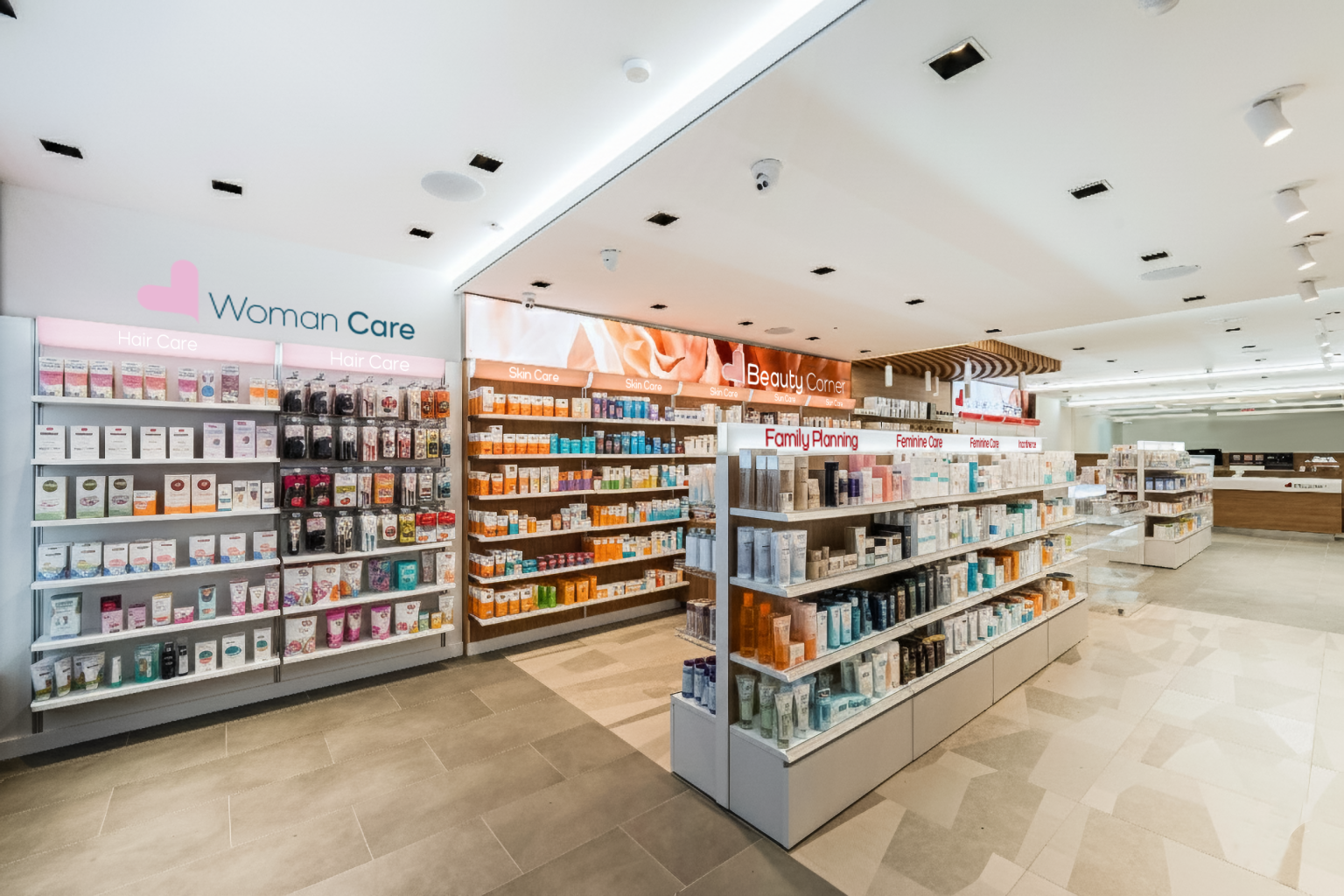
How would you design a pharmacy? This is the practical guide.
EU regulations and assessment of spaces and functions. Please find enclosed some practical advice, to be addressed to the pharmacist in order to cope with the appointed professional to re-design the Pharmacy.
You can get the link to download the REPORT free of charge: “Do you want to renovate your own Pharmacy WITH NO SURPRISES?”

Pharmacies are no more the place where patients exclusively purchase medicines. They are actually becoming a venue to go for any product connected to people’s beauty and wellness, and to be guided throughout a wide range of consultancies (make-up, food, blood test, pressure and so on). The retail space change entails a 360 degree reconsideration of spaces and their use within the Pharmacy. In addition to that, the clientele itself seems now to be more and more informed and demanding thanks to the net.
The present paper represents a TECHNICAL GUIDE upon how a pharmacy needs to be designed in order to provide:
1) a grounded instrument to verify the work of those professionals appointed to refurbish and renovate the retail space;
2) a new interpretation of the inner layout aiming at looking at a simple refurbishment as an opportunity to make the business get better.
The evaluation will be articulated throughout legal, functional and dimensional issues with useful advice and practical indications.
Internal Outfit: secrets behind a successful pharmacy design
It is mandatory throughout any pharmacy design to handle the spaces in accordance to the functional and organizational needs of the company, in compliance with the available metreage and the architectural guidelines. Last but not least, also in consideration of the retail criteria.
It is always good to remember that a pharmacy is a two-pronged activity looking at professional and commercial principles. The internal areas must be conceived to make the client be willing to buy.
The project must consequently be coped with by focusing on many aspects and not only on the organization of areas in relation to medical and prescription items.
Communication and clientele’s involvement are never secondary aspects when one looks at any successful undertaking.
It is necessary to foresee a variety of spaces to display the different products categories throughout a retail layout capable of attracting, captivating and communicating.
Consulting areas or analysis rooms will have to be studied and considered as well.
Once the strategy is set, the different spaces going through any pharmacy project will have to be distinguished. Each of them will comply with appropriate principles and criteria.
Retail Area
It is the area of interaction with the client. It is consequently the space in which the majority of communication choices must be considered. In this pharmacy area any corner must be implemented aiming at increase the sales and the services provided.
The patient’s “commercial pathways” will have to be accurately thought by marking the difference between seasonal promotions, “loss leaders”, impulse purchase accessories, specialized and “emotional” areas, and consulting spaces.
That being said, please find enclosed a few parameters and regulations to be taken on board throughout any pharmacy design:
- internal height (FFL_underside of ceiling) – 3,00 m;
- Cubic meters to be reserved to each professional – 10 m³;
- area to be reserved to each professional – 2 m²;
- Emergency exit: prerequisites of min. height – 2 m;
- Window-area to be opened to permit natural ventilation ≥ 1/8 as opposed to the flooring area; alternatively, in case of some technical hindrances properly documented, mechanical ventilation can be allowed as well;
- People with disabilities must be in a position to access the areas at all times.
Cabinets for consultancies and pharmacy services
- The dimension must be related to the range and volume of services provided. Should the cabinet be connected up to the suspended ceiling, the minimum area allowed is 9 m²;
- Respect for privacy (soundproofing, movable partitions to detach the cabinet from the retail area and the back storage);
- Access for people with disabilities.
- Adequate signage layout in order to support the in-house patient meandering;
- Minimum Internal Height (Floor Finish Level up to the underside of ceiling) – 3 m;
- Wall, paving and suspended ceiling must be finished with easily washable material and sanitized surfaces, with never sharp corners;
- Heating, Ventilation and Air Conditioning System tested to guarantee a healthy environment and an internal temperature without any major up and down.
Minimum requirements of premises for administration of either vaccines and serological tests within the Pharmacy
The Ministry of health is coping with the medical emergency, under discussion over these past few days, by foreseeing the possibility for any Pharmacy to take part in an extraordinary mass vaccine operation.
=> More details can be found in our other info docs
Back Area and spaces for Medicinal Product Storage
This is the focal point for the whole activity. It is in fact the space to lodge the spare medicinal products and all the other items to be ready-to-sell. The size of the environment is related to the available space and the specific needs.
A useful advice to guarantee a good design is:
- Minimum internal height – 2,40 mt;
- Wall and floor paving to be finished with materials easily washable;
- Window-area to be opened to permit natural ventilation ≥ 1/30 as opposed to the flooring area; alternatively, in case of some technical hindrances properly documented, mechanical ventilation can be allowed as well;
- Moisture protection;
- Fittings to be placed, with no sharp corners, in order not create hindrance for people at work;
- A constant in-house temperature of 25°C must be guaranteed, for storage condition of medical products;
- An easy communication between the storage room and the other rooms and/or outside spaces must be guaranteed (the latter case is to facilitate the loading / downloading of goods).
Sanitary Facilities and Changing Room
It is worth considering throughout a pharmacy design also the so-called “service rooms”, such as sanitary facilities and changing rooms. Please find enclosed a few indications and functional issues related to the two areas under consideration.
The sanitary facilities are a mandatory prerequisite and must:
- Have a minimum internal height – 2,70 m;
- Be adequately dimensioned in accordance to the employees’ number;
- Be organized per gender, however, should it not be possible and up to a maximum of 10 employees, a unisex restroom can be operating for both men and women;
- Be equipped with dressing room big enough to lodge a basin and towel appliances (to be treated as mandatory);
- Have both floor paving and walls to be finished with material easily washable up to the lowering level for drainage purposes;
- Have a minimum area for ventilation – 0,50 m² or, alternatively, a mechanical fancoil for HVAC purposes.
The changing room must be:
- Big enough to guarantee an easy walkable area;
- Equipped with wardrobes with separate compartments in order to insert working and civilian clothes not to be hung together and closed with lockable doors.
Galenic laboratory
This space is meant to be ruled in accordance to norms for good preparation.
It can take place within a specific environment (such as a room) or simply a “corner” (such as a sector) within a wider room; in the latter event the laboratory must be capable to be closed with movable partitions (no necessarily up to the ceiling) in order to prevent people from walking through during preparation procedures.
Some “simplified “ procedures state that, in case the working area cannot be separated, the preparation operations must take place during the closing time. Urgency cases are not contemplated. Especially in regard to medical preparation can be carried out during the pharmacy opening times. In the aforementioned case the access to the area must be controlled and restricted to the only medical preparation people.
It is important to distinguish between a laboratory organized for “sterile” preparations and “ non sterile” ones.
In the first case it is mandatory to consider:
- Minimum internal height – 2,70 m;
- The area to be allocated for such an activity can be separated, or foresee such an eventuality. This distinction is also useful to understand how to distribute the areas for such an activity;
- Wall and floor paving to be finished with materials easily washable and sanitizable;
- Window-area to be opened to permit natural ventilation ≥ 1/8 as opposed to the flooring area; alternatively, in case of some technical hindrances properly documented, mechanical ventilation can be allowed as well;
- Wash-basin with non-manual control;
- Dust extraction system, in case medical production is contemplated in conjunction with other products such as capsule, tablets, herbal teas and so on.
Concerning the laboratory for sterile galenic preparations, however, it is necessary to look at:
- Minimum internal height – 2,70 m;
- Surface ≥ 9 m²;
- Separation from the other preparation rooms;
- Access to be introduced by a dressroom where employees can leave their own clothing;
- Wall, ceiling and floor paving to be finished with materials easily washable and sanitizable, with round corners;
- Heating, Ventilation and Air Conditioning Mechanical System tested to guarantee a healthy environment and an internal temperature without any major up and down.
How to design a pharmacy: a practical sample

The sample of the pharmacy project which we want to realize is organized throughout an area of approx. 70 sqm subdivided in two main areas.
The first area takes place along a horseshoe-shaped pathway starting with the pharmacy access and getting to an end in front of the counter desk. It is an internal layout conceived to make clients go through the whole area, and encourage them to buy.
This part of premises is dedicated to the retail area and products display.
In addition to that, close to the counter desk dedicated to the delivery of medical prescriptions, it is foresee a space reserved to the client consultation.
The access area was considered to sell cosmetics and products not strictly related to the class of medications; beside an ethical desk, a further space is dedicated to natural products.
The “private” space is made of the operational desk, storage for stock items, wardrobe, dress room and WC Area, including the Pharma Drawers.
The pharmacy storage can be accessed either through an entrance door within the pharmacy and connected to the retail area, and through the outside area.
Last but not least, we have imagined a galenic laboratory not strictly connected with the other areas for security and hygiene purposes.
Did you appreciate this article? Do you want to carry on the reading and get further essential information?
Relevant EU Legislation
Before dealing with the pharmacy design, it is vital to start with the analysis of the existing legal frame.
Please find enclosed a breakdown of Italian laws modeled on the EU criteria upon the matter:
- dm 236/1989 – Technical guidelines needed to guarantee the access, adaptability and suitability of private premises and public residential dwellings in order to overcome and reduce any architectural barriers;
- law 13/1989 – Guidelines to incentivize the overcoming and elimination of architectural barriers within private dwellings;
- dpr 503/1996 – Regulation concerning norms for eliminating architectural barriers within building, spaces and public services;
- dpr 380/2001 – Consolidated Text referring to legislation and regulations in the construction field;
- lgs 81/08 Annex IV – Work safety on construction sites;
- dm 18 November 2003 – Procedures for installing magistral and medical preparations;
- Hygiene and Construction Code referring to the Council in which the project takes place;
- Regulation of Local Hygiene Commissions.
For the first time all the BACKGROUND and tricks operated by companies, architects and designers to make your renovation become “THEIR” BUSINESS will be revealed.
In line with all the refurbishments, also the pharmacy business can have issues, tricks and deceptions beneath.
- Timings getting spread through with no control,
- Unfulfilled promises and commitments
- Breathtaking increase of costs,
- Poor quality of materials and workmanship
They are only a few of the bunch of risks you may go towards… in spite of all the guarantees and reassurances of the sale manager.
Renovating a pharmacy means investing money within one’s own company with the aim of multiply the incomes in the time ahead. All the rest is secondary.
My name is Luca Sartoretto Verna, and throughout my career I have made available my expertise to carry out over 900 successful pharmacies. In the aforementioned report I will disclose all my state-of-the-art background (which is a MUST for you as well) in order to avoid transforming a “crucial” moment of your company in a real nightmare.