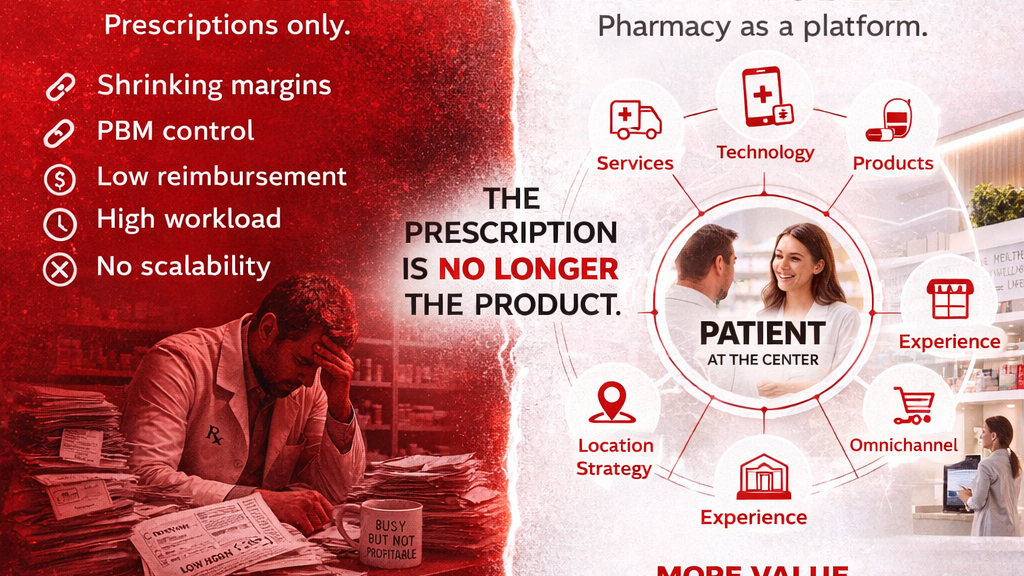
It was a rainy day in Rome. I was sitting inside one of the pharmacies we had designed when, out of curiosity, I decided to ask ChatGPT five questions about the future of independent pharmacy.
As an architect who has spent her career designing pharmacies around the world, I wanted to explore how artificial intelligence sees the challenges facing independent pharmacy owners.
The answers were interesting. But the fifth question made me think about something much bigger than technology.
Five Questions About the Future of Independent Pharmacy
1. Will independent pharmacies still exist in 10 years?
According to AI, yes. But not all of them.
The pharmacies that thrive will be those capable of moving beyond traditional prescription dispensing to create value through healthcare services, trust and patient experience.
Independent pharmacies have something powerful: the ability to build meaningful relationships with their communities. The challenge is turning that advantage into a sustainable business model.
2. What is the biggest mistake pharmacy owners are making today?
Trying to protect an old business model instead of developing a new one.
Pharmacy owners cannot control every market change, reimbursement policy or competitive pressure. But they can decide how their pharmacy operates, what services it provides and how customers experience it.
The future belongs to those who adapt, not simply those who resist change.
3. Where will future pharmacy revenue come from?
AI suggested a smarter combination of prescriptions, clinical services, prevention, wellness, specialized products and stronger patient relationships.
However, introducing new services is not automatically profitable. Every opportunity needs to be evaluated against customer demand, operational costs and financial sustainability.
This is where business strategy becomes as important as pharmacy design.
4. Will artificial intelligence replace pharmacists?
The answer was no, but AI will certainly transform the profession.
Technology can support administrative activities, information management and patient engagement, allowing pharmacists to dedicate more attention to their patients.
Yet one of the pharmacist’s greatest competitive advantages remains something technology cannot fully replicate: human trust.
As the World Health Organization highlights, community pharmacists are increasingly important frontline healthcare professionals.
5. If you could give pharmacy owners one piece of advice, what would it be?
This was the answer that caught my attention most:
Stop asking how to fit new services into your old pharmacy. Start asking what your pharmacy should look like if it were designed around the healthcare needs of the next 20 years.
Because you cannot build tomorrow’s pharmacy inside yesterday’s business model.
And often, you cannot deliver tomorrow’s healthcare experience inside yesterday’s layout.
Designing the Future of Independent Pharmacy Starts Today
For me, the most interesting part of this conversation was not what AI predicted, but the question it raised about architecture.
A pharmacy designed primarily around dispensing and product displays may struggle to accommodate consultation rooms, new healthcare services, personalized experiences and changing operational needs.
This is why, at Sartoretto Verna, we approach independent pharmacy design through our philosophy of Pharmacy Business Architects.
We believe that the starting point is not furniture or finishes, but understanding the business model and translating its ambitions into a space designed for growth.
AI can help us imagine the future. But turning that vision into reality requires strategy, architecture and a deep understanding of how pharmacies work.
And now, I have one final question for every independent pharmacy owner:
If you were opening your pharmacy from scratch tomorrow, would you design it exactly as it looks today?
Ready to Rethink Your Pharmacy?
Contact Sartoretto Verna and discover how strategic pharmacy design can help you prepare your business for the future.